The New Lone Ranger Is a Great Example of Hollywood’s Ongoing Destrution of American Culture

It looks more like Crazy Birdman and his side kick, the Masked Man.

It looks more like Crazy Birdman and his side kick, the Masked Man.

Wow! That has got to be one of the longest post titles I have ever written.

Anyway, unless you live in a cave or if you are free from the constant bombardment of video, radio and print ads, you know that Hollywood released yet another remake of a classic American story: The Lone Ranger. I have not seen this film yet and I don’t plan to, but I have read enough reviews and comments to give you me opinion.

Before I begin, let me tell you the story of the Lone Ranger as it was originally intended. Some of you probably know how the story goes because you listened to the radio show or watched Clayton Moore’s TV version, but many probably only know the crap they seen in theaters. The Lone Ranger was a member of the Texas Rangers named John Reid. One day, his squad, led by his brother, is chasing down the bandit leader Butch Cavendish. They are led into an ambush by a traitor and gunned down. Reid alone survives and is found by an Indian friend named Tonto, who nurses the wounded man back to health. Reid decides that he must bring Cavendish and his gang to justice, but in order to do so John Reid must die. So, they add another grave to those that Tonto had already dug to bury the other rangers. Reid fashions as mask to protect his identity. He is now the Lone Ranger. Once Cavendish and his men were captured and brought to justice, Tonto asked the Lone Ranger would remove the mask since his job was done. The Lone Ranger replied that there was still much work to do and many wrongs to right. The Lone Ranger than has adventure after adventure, first on the radio from 1933 to 1954 and then on TV from 1949 to 1957.

The Lone Ranger had several trademark that made him stand out from other westerns. He used silver bullets instead of lead as a kind of calling card and to remind himself that life, like siver, is valuable. When he was forced to shoot, he would shoot to wound, not kill. And of course, he had the William Tell Overture for his theme song.

Now, that I’ve taken us down memory lane for a bit, let’s return to the new Lone Ranger. From what I’ve read, John Reid in this film is a law student returning to Colby from the East. On the train, he encounters some Protestants, who sing their hymns badly and off-key. When the minister offers him a Bible, Reid holds up a law-book and tell the preacher that it is his bible. Shortly after he arrives, Butch Cavendish breaks out of jail. John is deputized by his brother Dan and they take a posse and ride after Cavendish. They are ambushed and Cavendish cuts out Dan’s heart and eats it. Tonto had been in jail, as well, and escaped, too. He come across the bodies and proceeds to bury them. He also witnesses a “spirit” horse resurrect John Reid as a “spirit walker” who cannot die. They then go off and seek revenge on Cavendish and the man behind him. There is also a brothel scene. And Tonto (Johnny Depp) has a dead crow on his head that he feeds from time to time. Also, the only prayer in the film is said by the bad guy. (What are they trying to say about Christians?)

First off, any similarities between the original Lone Ranger and this new creation are purely coincidental. The names may be similar, but the characters are not. Clayton Moor and Jay Silverheels, who played the Lone Ranger and Tonto in the 40s and 50s, knew they were role models for the youth and took that job seriously. In fact, Fran Striker, writer and co-creator of the Lone Ranger, gave the Ranger a creed which goes as follows:

I believe…

  • That to have a friend, a man must be one.
  • That all men are created equal and that everyone has within himself the power to make this a better world.
  • That God put the firewood there, but that every man must gather and light it himself.
  • In being prepared physically, mentally, and morally to fight when necessary for what is right.
  • That a man should make the most of what equipment he has.
  • That ‘this government of the people, by the people, and for the people’ shall live always.
  • That men should live by the rule of what is best for the greatest number.
  • That sooner or later…somewhere…somehow…we must settle with the world and make payment for what we have taken.
  • That all things change but truth, and that truth alone, lives on forever.
  • In my Creator, my country, my fellow man

Striker and George W. Trendle, the other co-creator, also wrote these guidelines for the Lone Ranger.

  • The Lone Ranger is never seen without his mask or a disguise.
  • With emphasis on logic, The Lone Ranger is never captured or held for any length of time by lawmen, avoiding his being unmasked.
  • The Lone Ranger always uses perfect grammar and precise speech completely devoid of slang and colloquial phrases, at all times.
  • When he has to use guns, The Lone Ranger never shoots to kill, but rather only to disarm his opponent as painlessly as possible.
  • Logically, too, The Lone Ranger never wins against hopeless odds; i.e., he is never seen escaping from a barrage of bullets merely by riding into the horizon.
  • Even though The Lone Ranger offers his aid to individuals or small groups, the ultimate objective of his story never fails to imply that their benefit is only a by-product of a greater achievement—the development of the west or our country. His adversaries are usually groups whose power is such that large areas are at stake.
  • Adversaries are never other than American to avoid criticism from minority groups. There were exceptions to this rule. He sometimes battled foreign agents, though their nation of origin was generally not named.
  • Names of unsympathetic characters are carefully chosen, never consisting of two names if it can be avoided, to avoid even further vicarious association—more often than not, a single nickname is selected.
  • The Lone Ranger never drinks or smokes and saloon scenes are usually interpreted as cafes, with waiters and food instead of bartenders and liquor.
  • Criminals are never shown in enviable positions of wealth or power, and they never appear as successful or glamorous.

As you can tell from my description of the new Long Ranger, he violated quite a few of these guideline, which were intended to create a good role model. And that is the biggest problem with today’s films. There are no more role models. Think about it. Would you want the “heroes” of most modern American films to be role models for your children? I hope not.  You want good example for your children, so they grow up to be God-fearing. Bible believing adults. Which interpretation of the Lone Ranger would most likely give you those results? It surely would not be the 2013 version.

This is just one example of Hollywood’s continued effort to destroy America’s Judeo-Christian culture by promoting characters (both real and imaginary) who are very destructive to the soul. They are using these degenerates that they call actors and writers to undermine values that have been held by Americans, and Christians, for many generations. If we want to turn the tide and stop this degeneration from spreading( at the very least in our families) we must steer clear of films, TV shows and other forms of entertainment that spiritually damaging. By writing this and similar posts, I hope to prevent people from exposing themselves to such soul rot as Hollywood now produces and provide you with a safer alternative.

Now for your enjoyment, here is the original Lone Ranger film from the 1940s.

For continued enjoyment you can listen to the Lone Ranger radio show here, here and here.

Green Hornet

Kato, remember where we parked.

Kato, remember where we parked.

While I’m talking about the new Lone Ranger film, I might as well talk about another film that came out rather recently that is related to the Lone Ranger character: the Green Hornet.

For those of you who do not know, the Green Hornet was in real life a newspaper owner named Britt Reid who ran a company by day and fought crime at night as the masked Green Hornet. The Green Hornet was aided in his fight for justice by his Japanese valet, Kato. Most people probably don’t know this, but Britt Reid is the Lone Ranger’s grandnephew. The Green Hornet has his own radio show from 1936 to 1948 and again in 1952. He also had a series of film serials in the 1940s and finally a TV show that ran from 1966 to 1967 starring Van Williams (Britt Reid/Green Hornet) and Bruce Lee (Kato). (Interestingly, Bruce Lee only agreed to take the role if he would talk normal English instead of pidgin English.)

Now the 2011 remake. Whereas, the original series portrayed the Green Hornet as a courageous man who wanted to bring gangsters and racketeers to justice, the 2011 Green Hornet (Seth Rogen) is a party boy who dons the mask after his father is killed. Rogen’s version leaves most of the thinking and fighting to his companion and makes a general klutz of himself. While I like the looks of the Black Beauty (the Green Hornet’s car), there is nothing else to like in it. It is as violent as most modern action films with partying klutz for a hero who fights a bed guys who is just as laughable.. What else is there to say?

Now, here, for your enjoyment, is a Green Hornet TV episode from the 1960s.

You can find the 1939 Green Hornet film serial on YouTube here. Also,you can enjoy the great Green Hornet radio show here.

If you found this article interesting or remember the original Lone Ranger and Green Hornet, leave a comment. If you watched either film, leave a comment with your opinion.

Posted in Movie Review, Old Time Radio, TV, Video | Tagged , , , | Leave a comment

Fr. John Emerson FSSP Speaks on the Original SSPX Break with Rome

A while ago I discovered an article from the Wanderer magazine from the 1990s in which they interviewed Fr. John Emerson FSSP on the subject of SSPX and the original break with Rome. Fr. Emerson was a member of the SSPX but left when Archbishop Lefebvre declared his intention to ordain four bishops against the wishes of Rome and Blessed Pope John Paul II. He shortly there after joined the Society of St. Peter. This is a very interesting interview and give a lot of insight into what exactly happened. You can download a PDF version of the interview here (scan of my original copy) and here (cleaned up copy) to share with your friends. The text in red is my emphasis. Please comment below if you find this interview interesting.

Fr John Emerson FSSP

Fr John Emerson FSSP

Q. Father, you are a priest of the Society of St. Peter. When and how did the Society come into being, how does It operate, and what is its purpose?
A. It came into being on July 18th, 1988, at a meeting at the Cistercian Abbey of Hauterive near Fribourg, Switzerland. We met there — I wasn’t yet a member, so I wasn’t there — the Society met there, about 10 priests and a number of seminarians, all of them, except one or two, persons who had just left the Society of St. Pius X because of the schismatic consecration of four bishops by Archbishop Lefebvre. They were all convinced this was not simply a further necessary disobedience in order to keep tradition alive, but a true break with Rome, and they could not in conscience go along with it — particularly after Rome had offered everything that Archbishop Lefebvre had ever wanted of substance. Rome had offered it all, and we were scandalized he refused it, truly scandalized. We weren’t simply surprised or unhappy, we were scandalized because he was our spiritual father and we trusted him, and he did not do in the end what was right.

Q. Perhaps we can conjecture later as to his motives. . .
A. Sure, we will.

Legitimate Rights

Q. The point to establish now is how does the Society operate. I have heard you say [in conversation before the interview] that it operates as an Institute of Pontifical Right. What does that mean?
A. That means that we are directly under the Pope through the Ecclesia Dei Commission and Cardinal Mayer. The Pope set up Ecclesia Del [i.e., the Commission] to deal with all traditionalist groups or even individuals who wish to reconcile themselves with Rome fully and not to follow Archbishop Lefebvre into schism. Those of the Society of St. Pius X who left founded the Society of St. Peter. Rome immediately approved that foundation provisionally and accepted the election of Fr. Bisig as the Superior General and then said that as quickly as possible they would raise it to the status of a Society of Pontifical Right, which, as I say, means that we do not have to go through the process of being under a diocesan bishop, which means he would be our direct superior and would decide everything regarding our life and future. Rome wants to deal with us directly. Rome knows there are bishops who are not interested, and even if we were simply under a bishop that would be something quite chancy in terms of the future. Rome wants traditionalists around the world to see that Rome is serious about giving traditionalists all their legitimate rights within the Church. So, the actual erection of the Society came exactly three months later on Oct. 18th, and as I said [again in earlier conversation] it normally takes 20, 30, 40 years for a new order to reach that status. We got it in three months. Again, that is proof Rome is behind us.
What it means in a practical way is that we can take seminarians and train them ourselves. We don’t need a bishop’s permission to take from his diocese those who wish to come to us. They enter us directly as they would enter directly into the Dominicans, the Salesians, or any group of that type, although we are not a Religious order. We don’t take the three vows, poverty, chastity and obedience. We only take a promise of obedience to the superiors.
Also, if a priest wants to leave his diocese or Religious order and come to us, we can directly incardinate him, if his bishop or order allows him to leave, which is normally the case when a man wants to change orders. We can accept them without having, again, to ask somebody else for permission. We can just take them immediately into the Society, and they are incardinated into the Society as a secular priest is incardinated into a diocese.

Q. You’re saying, in effect, that any priest has the right to join the Society of St. Peter.
A. That’s right. I might add, in regard to our end or purpose, it is of course orthodoxy as it is expressed particularly liturgically. We have been given the absolute right by the Vatican to use exclusively the liturgical books in force in 1962. Now that does not mean simply the missal. It means all the liturgical books. That means our ordinations are according to the old rite, that all the minor orders, exorcist, lector, etc., including subdeacon, are back in existence not only for us but for other traditional groups that I might talk about later that Rome has since reconciled or is in the process of reconciling. It means that those who come to our chapels will expect and will get Baptism, Confirmation Marriage in the old way.

The May 5th Agreement

Q. Okay, you’re emphasizing liturgical matters. Let me put something else to you. Really, it’s a question In two stages. First stage: Does the Society operate exactly as the Society of St. Pius X would have under terms of the May 5th, 1988 agreement [signed by Cardinal Ratzinger and Archbishop Lefebvre], had the Archbishop stuck with that?
A. Yes, except that he would have had a bishop and we do not. In other words, he would have had a bishop who would have been consecrated for the Society and for the traditionalist movement worldwide. We have to depend upon — and there has been absolutely no difficulty — local bishops or Curia cardinals or bishops who are willing to come and do the Ordinations and Confirmations and so on for us.

Q. Do you envision the day when you may have a bishop?
A. Well, yes, Rome talks of it for the future. For now it would be rather ridiculous for a community of 20 priests and 30 seminarians, as we are now, to have our own bishop. It was sensible for the Society of St. Pius X with 10 times that number.

Q. Okay, let’s get back to the second stage of the question at hand. The point I’m really getting at is that as part of the May 5th agreement, the Society of St. Pius X enjoyed the right to be able to raise doctrinal questions, such as notably in regard to the Vatican II Declaration on Religious Liberty. That is, they enjoyed the right provided they weren’t creating public furor. . .
A. That’s right.

Q. Well, does the Society of St. Peter enjoy this same right?
A. It does. It enjoys precisely that same right. Those who founded the Society had to sign absolutely no document of any kind regarding their adherence to the Council, and so on. But it was understood they were the part of the Society of St. Pius X which was willing to continue to accept the May 5th agreement. So it was understood that they had. . . . They said it openly, “Archbishop Lefebvre signed in our name, not only his own, we can continue to accept what he signed,” and then Rome said, “Fine, you are the ones with whom we will deal.”
Those of us who joined afterwards — I was the first to join after the actual foundation — did have to sign a page of doctrinal statements which were exactly, word-for-word, what Archbishop Lefebvre signed on May 5th. Obviously the other part, the practical part, fell out of relevance, but the doctrinal part remained important, and none of us has found — indeed, the Archbishop found — no serious difficulty in signing that. Indeed. we can continue to critique, without polemic, those parts of Vatican II which appear to us not to be in clear accord with tradition. And we are doing so. And Rome expects us to do so. It’s not a problem.
In fact, take one of those documents, the one, Church in the Modern World, it’s a dead letter in the  Vatican: They realize it was a document written with a sixties sort of optimism that is pointless today, and they just pay no attention to it.
Now on the other hand, the one on religious liberty is a, quote, bone of contention and will continue to be so. And, as I say, without polemic we are continuing to study the question. More actively, it’s being considered very seriously by a group of Dominicans who have reconciled themselves with Rome. They had five of their men ordained priests — again according to the old liturgy — in December, 1988, in France. They are going to be a very interesting group within the Church now.

The Schismatic Mentality

Q. We can get off on some of these other groups and associations later. Right now, you raised an interesting point en passant. You spoke of the consecration of the four bishops [by Archbishop Lefebvre] as not being a ‘necessary disobedience.’ I wonder If you would speak to the difference between disobedience and schism.
A. Yes, well, for example, the priests that Monsignor Lefebvre ordained, including myself, I never believed, and it was entirely clear from their attitude that Rome never seriously thought, this was in any way a schismatic act. It was purely disobedient. It was a disobedience which many of us were willing to go ahead and commit because we believed it was absolutely essential for the life: of the Church, for the health of the Church, that traditional liturgy continue and not simply disappear, and it seemed at the time that was the only way it was going to continue. Now, that can be argued, but in conscience we felt fully able to go ahead and do that without sin, without any kind of real suspension.
The consecration of bishops, on the other hand, is a clear act of schism, of breaking with the head of the Church, of setting up a parallel hierarchy, setting up an independent church. Of course that is exactly what schism is. It is not to be a heretic, which is to say, no, the Pope is, not head of the Church. It is to say, yes, he is, but we are simply going to ignore that and go ahead on our own.
Another part of schism, interestingly, is this: Even if one continues to say, yes, we are under the Pope, we obey the Pope, but it is then to break entirely with those who also are under the Pope, and that the Society of St. Pius X also has done very clearly since the break by considering utterly traditional groups like us, like the Abbey at La Barrou in France , to be now part of the Modernist conspiracy, if you like. In truth, we are in every way traditional, but we accept the Pope and we obey him. Therefore we are outside the pale. That, too, is classically the schismatic mentality.
It’s clear the Society [of St. Pius X] has accepted the dangers of a real schism and is just plowing ahead.

Apply To Rome Immediately

Q. All right, since we do keep speaking about other groups besides the Society of St. Peter, like the Abbey at La Barrou, we here in the United States probably have hundreds of sound priests who are In a kind of limbo or exile because they have been too orthodox. Bishops have dispensed with their services. Could priests like this form an association? What would they do if they formed an association? How would the mechanics for recognition work? To whom would they apply?
A: They would have to apply to Cardinal Mayer, to the Ecclesia Del Commission, and they should apply with as large a number of priests willing to go forward with it as possible, not just a few. The Ecclesia Dei Commission has specifically the task not only of dealing with already formed tradition al groups, but with groups that wish to form now that the possibility exists. Priests who have perhaps not said the old Mass but would love the chance to return to it, who do indeed want to have some kind of association with other priests maybe they don’t want to join us, for whatever reasons (and there’s no necessity that they should do so) — they really must apply to Rome immediately. They must let Rome knoW just how many of them there are. Rome is most interested to know.

Q. Are you familiar with the group I’m sorry, I can’t think of its name, I’ll have to look It up headed by Fr. LeBlanc?
A. In Arizona?

Q. At least they had a big meeting out there in Phoenix at the same time the Pope was in town. Are you familiar with them?
A. Not particularly. I’m afraid I’m very out of touch with things here.

Q. Well, I just wondered if they would qualify….
A. Well; they probably would, but they’d have to be willing. I mean, there are groups, alas like the Society of Pius X, who have hardened themselves against Rome and feel they can’t trust Rome. Well, all I can say is that Rome has fulfilled every part of its promises to us.

Q. Okay, let me get at this another way. At the Rome-end there must be some kind of test.
A. Do you mean a doctrinal test or just a practical one? How will you live?

Q. Yeah, well, make sure.
A. That you’re serious?

The First Step

Q. Look, I’ll be direct. There is a rumor that there has been on the Pope’s desk for some time a document awaiting his signature and which will, once it is signed, authorize any priest anywhere, and at any time to celebrate the Tridentine Mass. Do you know anything about this document?
A. Yes?…

Q. Does it exist?
A. Yes, it does, and it is on the Pope’s desk. Now, I think it only says that any priest will immediately be given, once this document is published, the right to say the old Mass privately, not publicly. But, it is meant to be the first step. And Rome is then going to watch and see. The document will be written in such a sense that it is meant to allow more public celebration, but won’t really say that too clearly yet. They want to see whether the bishops will finally get the point. If they still don’t, still refuse, then Rome will issue a further decree going over the bishops’ heads and saying, okay, from now on, those priests who wish to say the old Mass publicly may do so.

Q. Have you some authority you can publicly cite for believing in this two-stage approach?
A. No, but I can assure you that the authority I have it from is closely connected with it.

Q. In any case, during this interim period when the priest would be celebrating privately, well, to speak of a private Mass is not to speak of a priest being alone.
A. No, you’re quite right. And, again, this is what was explained to us by the people involved. It is meant to mean simply not one of the regularly scheduled Masses, but people could find out about it and come.

Q. In a word, it’s not posted on the board outside the door.
A. Not necessarily, no.

Q. Okay. Now, you’ve already said, I think, that you have 20 priests in the Society at this point. You are the only English speaking member?
A. I am the only native English- speaker.

Q. How many are studying at your seminary in Bavaria?
A. Well, 31, 29 of whom are for the Society of St. Peter. One was sent by a bishop in Spain who is interested in us. The other is sent by an interesting group of young people who have been brought together by an ex-Jesuit, a German man, who had to leave the Jesuit order because he refused to give up a Catholic scout movement which he had founded back about 15 years ago when it was clear that the Catholic scouting movement in Europe — not just Germany — was being perverted by Modernism. He is interested now in sending his people to us for training, so he sent one and he is very happy with us, so I expect we’ll have more from them. If we can accept them, because, as I say, 29 are currently for ourselves and about two-thirds of those were formerly seminarians in the Society of St. Pius X either in Germany or France. Ten are completely new people, and it would be very easy for us to accept, I’d say, about 40 or 50 new people for next year, we’ve been having so many applications from around the world. That’s the main reason I’m here right now. It is to interview the various people who have written to us and discover new people.

100% Behind Us

Q We want to speak of the pure pose of your trip in a bit.
A. All right, but the point is that the seminary will at least double in size by next year and so we’re going to have to start thinking about expanding in that sense: having another seminary. Anyway, Wigratzbad [location of the Society’s seminary in Bavaria] is interim for the French. The French want and expect to have, probably year after next, a seminary in France or French-speaking Switzerland. So they will leave and that will give more room. Of course, we ultimately want a seminary here.

Q. Right, but I suppose that for the time being any young man wishing to study with you would probably have to have at least some German and French.
A: French or German. I’m sure there are Frenchmen there who’ve been with us the past four months and haven’t spoken a word of German. So, one or the other. Both would obviously be better, but one or the other. French is certainly an easier language to learn. They should have a basic knowledge. That doesn’t mean any kind of fluency. That comes once you’re immersed in a place.

Q. Oh, I know. I arrived In Paris one day at three in the morning without a word of the language and stayed four years.
A. There you are.

Q. Before we get off on the purpose of your U.S. trip, already since the Society was formed a priest has been ordained for you?
A. That’s right.

Q. That Ordination was done by. . .
A. Cardinal Mayer, in Rome, in the German national church in Rome. It was, again, a magnificent solemn high Mass in the Tridentine Rite with the old pre-1968 form of Ordination.

Q. And that was on Dec. 10th, correct? And at the same time a subdeacon was ordained?
A. No, that was the original idea, but Cardinal Mayer said that he’d rather not do the two ceremonies together, so the two we had ready to be ordained subdeacon went to France and were ordained subdeacon there, along with those Dominicans I’ve mentioned earlier.

Q. In any case, something rather remarkable happened on Dec 12th that we’ve not heard shout in the States.
A. Really? Nothing? Interesting.

Q. I read the religious press pretty carefully, as does The Wanderer’s publisher, Mr. Matt, and neither of us has heard of this. What happened on Dec. 12th?
A. On Dec. 12th we have a private audience with the Pope, with John Paul II. We had asked for that, Cardinal Mayer presented the request personally to the Pope (it didn’t go through the usual channels), and it was granted. The point of its being granted is clear. The Pope wanted the Church to see that he was 100% behind us, 100% behind his own document, obviously Ecciesia Dei. He wants the Church to accept the fact that the traditional liturgy and a thoroughly orthodox priestly formation are now part of the post-Vatican II Church.
Now, the audience was not one where the Pope sat down and gave a long address to us or where we gave one to him. He simply met us. He talked with Fr. Bisig for about five minutes, then Fr. Bisig took him around the 40 of us who were there and introduced us, each one, to the Pope.

Q. The 40 being. . .
A. Seminarians and some of the priests. The French priests had to get back to France: That’s where we’ve found most of our apostolic work up until now.

Q. In any case, it would seem correct to say that the Pope meant a public demonstration of support for the Society.
A. Absolutely. No question at all. And indeed though we knew very well there were those who would try to keep the audience from happening, the fact is he didn’t just automatically grant it as he would to just any other group. We are certainly controversial in the sense that the Modernists don’t like us at all. And the Pope was showing he doesn’t care.
Now another point. The French bishops, some of them, are also very unhappy that we exist and tried to stop the Ordinations in France for these Dominicans. The Ordinations went ahead, although Cardinal Mayer decided not to come to France and do them. He stayed in Rome, and a retired French Archbishop, indeed, a Holy Ghost Bishop who had been installed by Archbishop Lefebvre, came and did the Ordinations. But Rome made the point, ‘‘You are not going to be able to stop this. This is irreversible. What we are doing for the traditionalists is irreversible and it will not be changed.” The German Bishops, when they had their first full session after we were established in Germany, unanimously sent a letter to Rome — you know how they are in these meetings, even those who are for us don’t dare say anything — unanimously sent a letter to Rome saying, ‘We want this Society and this seminary to be only for people who left Archbishop Lefebvre and to cease to exist once they have been ordained and been integrated into the wider Church.” And Rome wrote back and said, “You have no right to say anything about it. This is a Society of Pontifical Right. Like any other, it has all the rights, and will continue to have all the rights, of any other group within the Church that has the same Pontifical Right. Therefore, we reject out of hand what you’ve said.” Obviously, the language was more diplomatic, but that was its meaning.

Active As Soon As Possible

Q. Excellent. Well, then, let’s turn to it1 What is the purpose of your trip to the United States?
A. I’m here to interview those young men who have written us regarding entering the seminary. Now , I came here with 18 names. This was without very much publicity for the Society. I’ve also met with another 10 in the time I’ve been here.

Q. This is in addition to priests.
A. Yes, in addition to priests. I’ve met with about two dozen priests who are at least interested in information about us. Two have definitely applied to join. That is, two priests, and about 10 of the possible seminarians I’ve so far seen have also definitely applied and others are still thinking about it. And I’m still in the first part of my trip. I haven’t got to the Midwest.

Q. You’ve only been here three weeks, right?
A. That’s right.

Q. What areas of the country will you be visiting?
A. After here, I’ll be going to Minneapolis/St. Paul and then to Chicago, but only for a day, and then to Kansas City, then to California and then, I just discovered today, a group in Seattle wants to see me.

Q. I bet they do.
A. And other places will clearly come along. I don’t need to go back to Germany at any particular date. I mean I’ll stay as long as I find things to do.

Q. When do you hope the Society to become active in the United States?
A. I would expect it as soon as possible, as soon as something practical could be worked out, because bishops around the world have expressed an interest. Actually, an entire episcopal conference in Africa has already written to us and asked us to provide a priest.

Q. Can you identify the nation?
A. Yes, I can. It’s Gabon.

Q. That doesn’t surprise me. There’s a St. Pius X mission there, isn’t there?
A. Yes, that’s right. That’s probably one of the reasons they’d like us to come to keep the people within the Church. But I should tell you where we are active. We are active in Salzburg, Stuttgart, in Lyons, in a number of other places in southern France, Versailles. . .

Q. When you speak of being active. . .
A. I mean we have chapels. The bishops have allowed us in and are happy to have us there and are working with us and we’re working with them. Paris, by the way, is being worked out with Cardinal Lustiger. It may be there already.

Q. Okay.
A. We’re very, very happy with the new Archbishop of Salzburg. It was the first place where we were given a chapel, in early July, and this parish priest, Georg Eder, started sending us weekly or monthly checks from that moment. And he is now the new Archbishop of Salzburg. And so we expect to be given an even larger church.

Q. The Society’s planning to become active in South America also, I presume.
A. Oh, certainly. Unfortunately, we haven’t any South American priests, or even any Spanish- speaking ones, yet. So, it will take time.

Q. What are the relations between the Society of St. Peter and the Society of St. Plus X?
A. There are no formal relations, of course. Archbishop Lefebvre was interviewed in August and he was asked that very question, and he said, “None.” He said, “I will not even answer letters written to me by former members of the Society.”

Q. You feel no animosity, that’s the point.
A. No, we don’t. They do. Certainly they express it.

Stacks of Mail

Q. Okay, this question has not to do with priests seeking to become members of the Society of St. Peter, but with other priests, perhaps especially with diocesan, secular priests. What is necessary for a priest to obtain a celebret from Cardinal Mayer’s Commission?
A. Well, they need to be in good standing with their bishop. A traditionalist priest who has gone off on his own would have a little bit more difficult time, because he obviously would have to deal with the bishop from a position of irregularity. However, priests who were in good standing should write to Rome immediately, if they haven’t already done so, explain their positions, say they want a celebret, and they will probably be given it by return mail. It’s even better, of course, if they can go to Rome and discuss it and explain the whole situation, but that’s obvi6usly not possible for most, and so it isn’t necessary. Msgr. Perle [the secretary of the Ecclesia Dei Commission, who visited us in Wigratzb ad over the Christmas holidays, said they have received stacks and stacks and stacks of letters — he went like this, he raised his hand above the table — from priests asking for the celebret, and he said they are mostly, 80% of them, from priests under 33.

Q. Eighty percent!
A. Eighty percent. And remember this, the Ecclesia Dei Commission was expected to need two years to finish its work of integration of traditionalist communities. They now think it will be at least five. They’ve had to get another priest for the English-speaking correspondence alone. So, they’re snowed under. They have much, much more to do than they expected. And this of course has impressed the Pope greatly, and particularly the fact that these are young priests.

Q. You’re not suggesting that the Commission would like to see the flow of mail stop?
A. Oh, no, far from it.

Q. Speak to that point. What do you mean when you say far from it?
A. Well, this is the thing about the Ecclesia Dei Commission that is not understood by traditionalists who are wary of Rome: Cardinal Mayer, Msgr. Perle, and the priests who are working there are enthusiastically behind what they are doing. They’re not simply Vatican functionaries. They are delighted to see the old liturgy return, and are doing everything they can to put it forward. And of course the more letters that come in, the less can the opposition say that this is a pointless exercise. You see, the more letters that can be presented to the Pope, there is more proof that this is a very, very active issue among Catholics, that this is something people have been waiting for for years and they are overjoyed that they can have it. It can only strengthen loyalty to the Papacy around the world, if it goes ahead as quickly as possible. In fact, if it doesn’t go ahead quickly, if people still wait a year or later and still are not getting things, they will be terribly disappointed and will be likely to go over to Archbishop Lefebvre.

Q. Then ordinary faithful Catholics in X diocese who desire the historical Mass, who petition their ordinary for it, should probably send copies of their petitions to the Commission.
A. Absolutely.

Q. Even before they have a response from the bishop?
A. Well, no, they should wait. And if the response is negative they should send off both sides of the correspondence.

Q. What about when they receive no response at all? Some bishops are stonewalling.
A. Well, yes, then of course they should let Rome know that. Say: “We’ve written this letter, enclosed a copy, three months have passed, and nothing has happened” That’s pretty eloquent, too, as to what the bishop is doing. And Rome, again, wants to see this because they are expecting bishops to obey.

Q. Okay, now this question reverts to your current trip. One is impressed by the number of priests and would-be seminarians who are contacting you, but how is word getting out?
A. It is word of mouth.

Q. Up until now, when you fin ally begin to receive some publicity.
A. You know, I met with 10 priests one afternoon in Connecticut. One priest came all the way down from Canada to be there. And, again, except for one, these were all priests 40 years old or younger.

Q. Okay, let me ask this. What happens when a group of Catholics petitions a bishop, and the bishop proves intransigent, how can he be made to respond generously to their desires under the terms of Ecclesia Del? I guess you’re saying that right now there is no way to make him.
A. The bishop can’t be forced, no. Rome doesn’t want, yet, to force them. However, I think the Pope wanted to solve the problem the day he was elected, and he and Archbishop Lefebvre met a month after his election in November, 1978. Archbishop Lefebvre — I wasn’t in the Society, but people tell me — that the Archbishop came back wreathed in smiles and said, “We’re going to have an agreement. It’s coming. Soon. Right away.” But then it didn’t happen. The point is the Archbishop would have jumped at the chance to sign the May 5th agreement of 1988 had it been presented to him in 1978. Not only would he have signed it, he would never have gone back on it.

In Order

Q. Before we end this, I wonder if a little bit more needs to be said about the constitutional connection between the Society and the Ecclesia Dei Commission.
A. Well, it’s not a constitutional connection. It’s an interesting quest ion, though, because the Ecclesia Dei Commission is only a temporary group, and in 10 years it will probably no longer exist. And then we and other traditional groups will be reinserted within the normal channel of command, and will be under the Congregation for Religious, and the Prefect of that Congregation of course reports to the Pope. But now the Pope wants everything done at speed, and with a Cardinal and a small group of people who can go directly to him at any time so that things can’ be done quickly without blockage from various other groupings.

Q. Okay.
A. Now, that won’t last forever, but it’s going to last until everything is in order and normal, if you like.

Q. Mayer then has direct access?
A. Oh, yes.

Q. Excellent. Now, we said earlier that we’d get to this: Why do you think Archbishop Lefebvre did not follow through on the May 5th agreement?
A. Briefly, because he had lost basic trust in the Vatican. And. . .

Q. I see you want to say more, and I would love to draw you out on it, but we need to wind this up and I want to ask you about your own role, your own future. Are you going to be, at least for some time to come, a sort of missionary to the English-speaking world for the Society?
A. Yes, although that is not good for oneself. I mean, I can’t just be spending my priestly life traveling about. I must have a base. And that, I hope, will come as soon as possible. We will go wherever a bishop allows us to, and if the first bishop to allow the Society to establish itself turns out to be in England, that’s where I’ll go, or Ireland, that’s where I would go. So peop1e there will have to pray very hard if they want the Society here, pray, that is, that a bishop in this country will offer us something.

Sidebar

As John Henry Newman observed of this kind of spirituality almost 150 years ago:
“We are alarmed at any call to national or personal humiliation and amendment . . . we like to abandon ourselves to the satisfaction of religion, we do not like to hear of its seventies. . . . We are cherishing a shallow religion, a hollow religion, which will not profit us in the day of trouble. . . . The age, whatever be its peculiar excellences, has this serious defect, it loves an exclusively cheerful religion. It is determined to make religion bright and sunny and joyous, whatever be the form of it which it adopts. And it will handle the Catholic doctrine in this spirit . . . it will substitute its human cistern for the well of truth; it will be afraid of the deep well, the abyss of God’s judgments and God’s mercies.
“Surely we are pretending allegiance to the Church to no purpose, or rather to our own serious injury, if we select her doctrines and precepts at our pleasure; choose this, reject that; take what is beautiful and attractive, shrink from what is stem and painful” (Sermons on the Subjects of the Day, pp. 116-117).


Posted in FSSP, Latin Mass, Roman Catholic, SSPX | Tagged , , , | 2 Comments

The Alamo (1960), A Patriotic Film Every American Should See

Like most of you, I enjoy a good movie. However, now days it is harder and harder to find a decent, especially one you can show to your entire family. Your best option is to pick a film from years gone by. Today, I would like to talk about one of my favorite films: John Wayne’s The Alamo.

John Wayne had wanted to make a movie about the Alamo for many years. In 1955, while he was at Republic Pictures, John Wayne tried to get the green-light to direct an Alamo film. He even had a script written. Unfortunately, the wanted him to star, not direct. Ultimately, Wayne left and formed his own production company. He was forced to leave the script behind at Republic. The script was later rewritten and released as Last Command.

Meanwhile, John Wayne was working on his version. He had a replica of the Alamo built on his property. He mortgaged his boat and other items to pay for the film. He gathered big name actors to fill out the cast, including Richard Widmark (Jim Bowie), Laurence Harvey (Col. William Travis), Frankie Avalon (Smitty), Ken Curtis (Captain Almeron Dickinson), Richard Boone (General Sam Houston) and Chill Wills (Beekeeper). John Wayne played Col. Davy Crockett.
The resulting film was a two hours long show of heroism, courage, patriotism. In one of my favorite scenes in the beginning of the film, Davy Crockett (John Wayne) tell Flaca, a young Mexican girl, the importance of standing up for what’s right. This single speech encapsulates what this movie is about.

There is a Catholic tie to this film that most do not know about if they have not seen the make of documentary. Before filming started, a Franciscan friar blessed the set. During filming, no one was seriously hurt (except for a canon running over Laurence Harvey’s foot). On another occasion, while Wayne was directing a scene, he heard some women talking behind him. Wayne whipped around and told them to “shut $#$@ up”. The next thing he said was, “I’m sorry about that, sisters.” Several nuns were visiting from a nearby convent. A sheepish Wayne gave them a tour of the set. Interestingly, Wayne’s grandson, Fr. Matthew Muñoz, is a Catholic priest and Wayne himself converted in the 1970s.

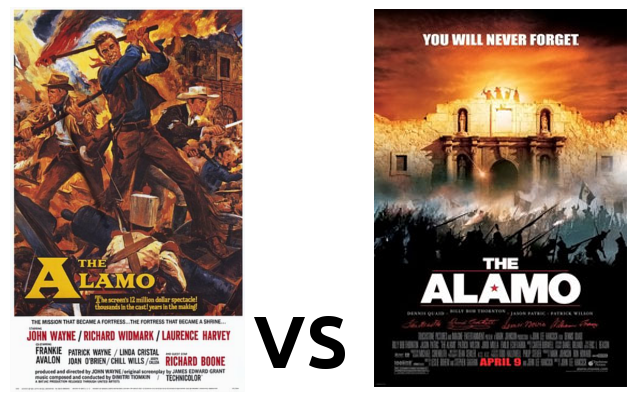
Alamo 1960 vs 2004

1960 vs 2004

Now, I would compare how this 1960 film compares with the more recent (and inferior) 2004 version. And remember there is no bias in this review whatsoever.

While the 2004 version focused more on the events that led to the siege of the Alamo, the 1960 version focused on the defenders and what they went through.

One of the big differences between the two films is how the two films treated the slaves inside the Alamo. In the 2004 version, the slaves are concerned with getting out of the Alamo alive, regardless of what happened to their masters. In the 1960 version, the sole slave is an old man owned by Jim Bowie. The night before the final battle, Jim Bowie gives his slave a piece of paper give him his freedom. The old man looked at the paper and said, “Mr. Bowie, it seems that freedom is what you people are fighting for. So, I guess I’ll stay here.”

Secondly, the 1960 version had more of a spiritual tone to it (which is not at all surprising.) The night before the final battle, the defenders muse about what the afterlife will be like. One says, “There is no hereafter.” After which the old slave wonders how could anyone not believe in an afterlife. In the beginning of the film, when they find the Alamo, one of Crockett’s men (Parson) offers a prayer of thanksgiving. One of the men remarks that Parson has a prayer for everything.

All in all, the Alamo (1960) is a great film and you should go and watch it.

Posted in Movie Review | Tagged , , | Leave a comment

The Non-Existent Catholic Voice in America

Monday night I attended a Fortnight For Freedom talk at a local church. It was given by a local Franciscan nun. Unfortunately, this talk was representative of current condition of the Catholic Church. Not once did the sister mention sin or its consequences. Not once did she say that abortion and contraception are sinful practices and those who take part in them should go to confession or risk their soul. Instead she gave an overview of how the world had changed, but the Church had remained a beacon of light in the world. While this was true, it is no longer.

The Church, whose purpose is to care for souls and help them get to heaven, is no longer the vocal protector of freedom and proclaimer of the Gospel. Instead it has become more concerned with social and material issues and being politically correct.

Before I go any further, a little history lesson is necessary. In October of 1884, Pope Leo XIII was given a Divine warning after offering Mass in his private chapel. As he was preparing to leave the altar, he heard two voices. One was the guttural voice of Satan and the other was the softer voice of Our Lord. Satan told Our Lord that he could destroy His Church. Our Lord told him to do so if he could. Satan replied that he needed more time and more power. When Our Lord asked Satan how much time and how much power he needed, Satan said 75 to 100 years, and a greater power over those who will give themselves over to his service. Our Lord granted him the time and the power. Pope Leo immediately went to his office and composed the prayer to St. Michael and ordered that it be said after all Low Masses.

Now, you probably have two questions. First, Why would Our Lord allow this? Like Job in the bible, this is a test for all mankind. But it is also a testament of God’s power and his promise because in the end He alone will triumph. Second, you’ll ask, how come nothing happened in those 75 to 100 years? After all, the Church still exists. Well, something did happen. On January 25th, 1959, Pope John XXIII announced his intention to call the Second Vatican Council. The year 1959 is 75 years after Pope Leo’s vision.

The Second Vatican Council marked a turning point in the Church. It is the dividing line in the modern history of the Church. It was begun by John XXIII with good intension, but it resulted in vague documents, which in turn led to loss of faith and loss of discipline around the world. In short, it was a rupture unlike any previously seen in the Church.

I would like to state before I go any further that I am a Roman Catholic dedicated the Roman Catholic Church and to her head Pope Francis. I am not a supporter of SSPX, CMRI or any of those other renegade “independent catholic” groups. If you thought I was, you must be new to this blog. I am, however, a lover of the Roman Catholic Faith who is greatly saddened and hurt by her current, sorry state.

To continue. While John XXIII had good intentions when he launched Vatican II, good intentions don’t make a whole lot of difference in the grand scheme of things. In 1972, Pope Paul VI told the world that “through some crack the smoke of satan has entered into the temple of God”. If the Supreme Pontiff said that back in the 70s, just think how bad the condition of the Church is now.

The major problem that resulted from Vatican II was a wussification of the Church. Now the Church is more interested in getting along with the world instead of converting it. The focus is on “openness” to other “faith communities” (and worse, non-faith communities). Bishops want to “get along” and not rock the boat. They refuse to fight heresy and in some cases support it. This would never have happened before Vatican II.

I spoke of a loss of discipline. In particular, I am speaking of the shortening of the fast before Mass, the utter lack of confession before Mass and the end of the Friday abstinence from meat. The first and the last were both sacrifices to curb the body and strengthen the soul, but today hardly anyone abstains from meat on Fridays because they think it was abolished by Vatican II.

Sin has become such a way of life, that many in the Church fear that if they call a sin a sin they will lose popularity. They forget that life is not a popularity contest, but a journey to either heaven or hell. It has gotten so bad that bishops and cardinals are openly laughing and joking with public sinners, Catholics who openly oppose the Church’s teaching and still claim to be Catholic. Princes of heaven are now trying to gain favor with the princes of earth. Before Vatican II, when bishops were not afraid to use their power, they brought kings and princes to their knees. Henry IX, the Holy Roman Emperor, was excommunicated by Pope Gregory VII. Henry journeyed to where the Pope was staying and knelt in the snow for three days as a sign of penance. Popes in the past have regularly excommunicated monarchs and absolved their citizens from obedience to those monarchs.

As I said before, many leaders in the Church are worried about the material and not the spiritual, They fight for immigration reform and environmental protection, when they should be fighting abortion, same-sex marriages and working to protect religious liberty. Many pay lip service to fighting abortion or same-sex marriages, but are not strong enough in their efforts. In fact, a pro-life activist once said that if all the bishops in the US got together, they could stop abortion in the US for good.

It is now time to throw off the chains of political correctness and the bonds of popularity. It is time to preach the plain Gospel. It is time to call sin sin, to warn people that a life of sin is rewarded with the eternal punishments of hell. We must fight evil with prayer, penance and words. Remember the Rosary is our best weapon in these trying times. Use it and the devil will flee. My God save us and save His Church.

Posted in Bishops, Catholic, Discipline, Heresy, Liberalism, Lukewarm, Roman Catholic, Vatican II | Tagged , , , , | 1 Comment

Pictures from Pentecost 2013 High Mass

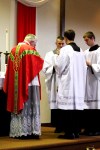
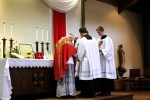
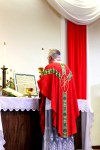
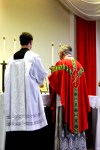
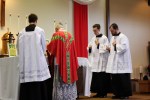
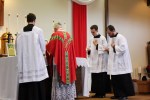
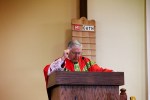
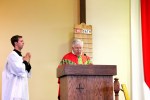
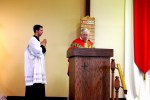
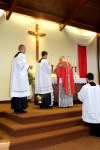
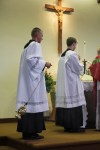
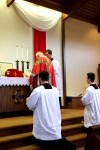
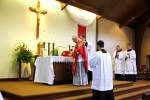
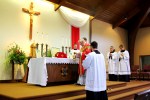
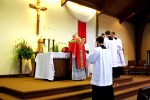
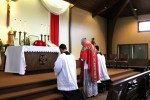
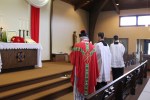
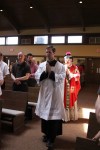
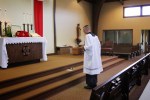
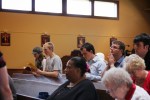
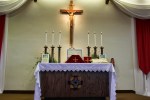
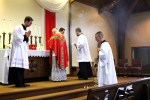
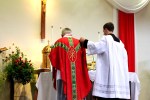
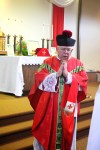
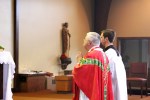
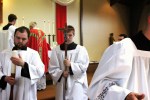
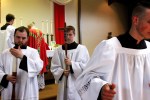
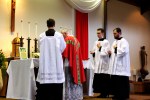
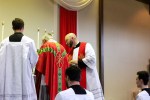
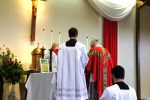
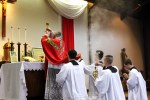
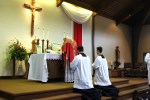
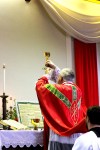
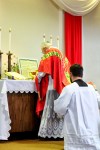
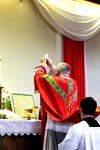
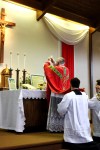
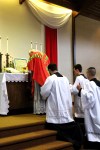
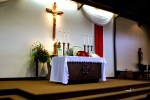
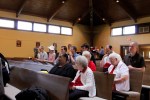
I’ve been meaning to post these pictures, but I have been very busy lately. On Pentecost Sunday, my parish church had the first Latin Mass since the new church building was constructed in the 1970s. The Mass was sponsored by Juventutem Michigan, a Catholic youth group dedicated to the Latin Mass. The Mass was offered by Monsignor Edward A. Hankiewicz. My brother Michael and I served the Mass. This was the first High Mass the we ever served, we have served Low Mass many times. A friend of ours brought two of his brothers to help. There were about 60 people in attendance, which was great for a first time. Please pray that we can get the Latin Mass on a regular basis at St. Mary’s.


Posted in Altar Boy, Juventutem Michigan, Latin Mass, Priest, Roman Catholic | Tagged , , , | Leave a comment

Altar Serving Book – Introduction and Purpose of Altar Boys

This post will be the first of several posts that I will write on altar serving. I’m writing this for two reasons. First, I want to inspire those who are currently altar boys to become better. Second, I want to inspire boys who are not servers to consider taking up this great service and duty. I hope to eventually release a full ebook for free, once I think I have covered all of the topics relating to being an altar boy. I will keep you up to date in the project.

Introduction

To start off, I would like to get my credentials out of the way or, to put it another way, what qualifies me to talk about altar serving. Well, I’ve been an altar boy for over 15 years and for about 14 of those years I have served with my younger brother. We have served mostly English Novus Ordo Masses, but we’ve also served a few Polish Novus Ordo Masses. About three years ago, we learned how to serve the Latin Tridentine Mass. For going on two years we have been serving Mass 6 days a week for our pastor. We have been serving for a while and have the scars to prove it.

You will probably notice that during the course of this and the other serving posts, I will predominantly use the phrase “altar boys” instead of “altar servers”. This is because I believe that serving is an office and a job that should be for boys only. Serving has led many boys to consider entering the priesthood. This makes sense for boys, but what about girls? First, get the people used to girls in the sanctuary wearing liturgical clothing and, then, they won’t notice it when you start pushing women priests.

AltarBoyPaintingPurpose of Altar Boys

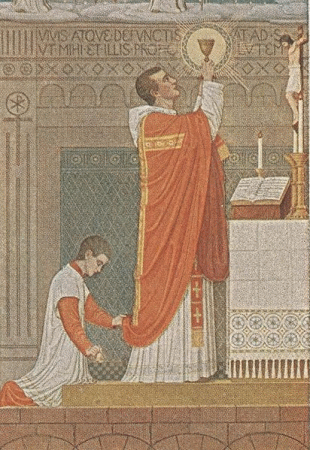
At the altar, an altar boy serves two functions that lead to one result. The first function is to help the priest. This might be obvious or common sense to many, but that does not mean everyone gets it. A well trained sever will be able anticipate what the priest will need and when. This is crucial because if the priest can be sure that, for example, the Missal is at the correct place on the altar when he needs it, then he can relax and focus on more important parts of the Mass. I have seen many times when a priest has had to prompt altar servers to bring him something. This makes for an awkward pause while the priest waits to receive what he asked for. The Mass flows much better when there are few to none of these awkward pauses. It takes time for the altar boy to get to know what the priest wants, but when he does everything flows better.

The second function of an altar boy is to help lead the people. This is more the case in the Latin Tridentine Mass, but it is also true in the English Mass. In the Latin Mass, the people often could not hear the priest, especially in the days before microphones. They could tell where the priest was in the Mass by what he did and what he occasionally said out loud. They also took their cues from the altar boys. For example, when altar boys knelt after the Gospel (or the homily, if there was one), then the people sat. The same is true for the English Mass. The altar boy act as a guide to show the people what they should be doing at certain parts of the Mass, whether it is kneeling or sitting or standing.

The result that should occur, if the two functions are performed correctly, is an increase in reverence in the parish community. While it may not be obvious to many, how altar boys act while they are around the altar can affect how the people in the pew pray and worship God. A server, who does his job well, will uplift those who watch him. They will come to have a greater appreciation for what takes place on the altar and also a greater reverence. If the congregation sees reverence around the altar, they will be inspired to reflect that reverence in their worship. Make no mistake, serving is a very important job that should be taken seriously because it can have a great affect on how people pray.

I hope you found this post interesting and enlightening. Please give me some feedback in the comments section below.

Posted in Altar Boy, Latin Mass, Mass, Roman Catholic, Serving Book | Tagged , , | 5 Comments

All Altar Boys Should Know How to Use a Thurible

The thurible is an important piece of liturgical equipment that all altar boys should know how to use. Unfortunately, just because they should know how to use it does not mean that most do know. Here is a video that demonstrates the best way to use a thurible.

This clip is from the TV show Human Target, about a man who goes undercover to protect people.

Posted in Altar Boy, Humor, Video | Tagged , , | Leave a comment

Blessed Charles de Foucauld (September 15, 1858 – December 1, 1916)

Blessed Charles De Foucauld

Blessed Charles De Foucauld

Blessed Charles de Foucauld was born on September 15, 1858 in Strasbourg, France to an aristocratic family. After losing his parent at the age of six, Charles and his sister were raised by their grandfather. While he was in high school, Charles was introduced to the rationalism and skepticism of Voltaire and others. As a result, lost his faith and no longer believed that God existed. Without a moral compass, he spent much of his inheritance enjoying the best food and wine, enjoying the good life. He followed his grandfather’s footsteps and entered the officer’s training program at the French military academy. However, he barely graduated from the military academy because of laziness and drunkenness. As a second lieutenant, Charles spent his time horseback riding and high stakes gambling. All his meals were catered by the finest restaurants and he employed his own tailors. He even brought women from Paris for companionship. He earned the contempt of his peers by insisting that his mistress accompany him to social events for military officers.

In spite of his decadent lifestyle, a spark of duty still existed in his soul. Charles surprised everyone by volunteering for a dangerous assignment in North Africa. While there he won praise for his leadership skills and courage. Shortly afterwards, having proved himself, Charles resigned from the French Army. Charles was impressed by both the faith of the African Muslims and the vastness of the African desert. In June of 1883, Charles started an exploration and research tour of Morocco disguised as a Russian Jew. As a result of this expedition, Charles wrote a book about his experience with some of the most accurate descriptions and maps up to that time. He received a gold medal from the French Geographic Society for this work. Meanwhile, his soul had been stirred to greater hunger for faith, due to the faith of the people he encountered. However, his skepticism held him back. One night, he entered a church that was dark except for a small sanctuary candle before the tabernacle. Kneeling, Charles prayed, “My Go, if you exist let me know.”

Back in France, Charles began a quest to find God. In this quest, he was aided by his cousin Marie. She would talk to him for hours about faith and gave him books to read on the subject. Finally, she convinced him to talk to her confessor, Abee Henri Huvelin, a priest of great holiness. Late in October of 1886, Charles went to visit the priest and found him in the confessional. Instead of kneeling, Charles leaned forward and said, “Father, I have not faith. I have come to ask you to instruct me.” The Abbe replied that if he knelt and confessed his sins he would believe. He obeyed and confessed his sins. Upon receiving absolution, Charles was told by the Abbe to go to Communion. It was here at the Altar of God, that Charles eyes were opened to the truth. He said, “As soon as I came to believe there was a God, I understood that I could not do otherwise than live only for Him alone.”

In 1888, Charles visited the Holy Land. Here he fell in love with Nazareth and the hidden, ordinary life of the Holy Family. Two years later, he entered the Trappist monastery in Syria. However, this only lasted for seven years because even this order renowned for its austerity and rigor was not enough. When the monks were allowed to butter their cooked vegetables, Charles decided that he needed more mortification, not less. He left the monastery and became a hermit in Nazareth. He was ordained a priest in June of 1901. After his ordination, he moved to North Africa and lived as a hermit among the Muslims. He spent his time translating the Gospels into the Touareg language and caring for the poor and forgotten. Most nights were spent in adoration of the Blessed Sacrament. He wrote, “What a tremendous delight, my God!  To spend fifteen hours without anything else to do but look at You and tell You, ‘Lord I love You!’ Oh what sweet delight!” “The goal of every human life should be the adoration of the Blessed Sacrament.”

When war broke out in Europe, the Muslim tribes took advantage of the situation and started to rebel against the French. Charles built a small fort around his hermitage, hoping to create a sanctuary for the locals if fighting should breakout. However, he was capture by tribesmen who hoped to use him as leverage. They bound him and tortured him. Finally, they shot him when he refused to renounce his faith in favor of Islam. Charles had sensed how he would die early on. In 1897, he wrote, “Remember that you ought to die as a martyr . . . killed violently and painfully . . . Remember that your death must inevitably flow out of your life, and on that account, realize the insignificance of a great many things.” He was beatified by Pope Benedict XVI on November 13, 2005. He is honored on December 1.

Posted in Priest, Roman Catholic, Saints | Tagged , , | Leave a comment

Cardinal Dolan, the Man Who Must Never be Pope

Before the conclave took place, there was quite a bit of speculation that an American would be chosen to lead the Church. One name in particular led the list: Cardinal Timothy Dolan. On the surface, Dolan looks good. He’s happy and jolly, seems to be relatively conservative, but once you scratch below the surface you find something different. Watch below and be thankful that Dolan was not elected.

Posted in Cardinal Timothy Dolan, Liberalism, Modernism, Video | Tagged , , , | 2 Comments

St. Gianna Molla (October 4, 1922 – April 28, 1962)

St. Gianna Molla

St. Gianna Molla

Gianna decided that medicine was the career for her to best help others. To accomplish this, she entered medical school in November of 1942 in Milan.  She graduated in 1949 and opened an office near her hometown. Her brother was a missionary priest to Brazil. Gianna wanted to join him to offer her services to poor women, but her poor health made that impossible. On December 8, 1954, Gianna attended the first Mass of a young priest named Fr. Garavaglia from the town of Mesero. Another native of Mesero named Pietro Mollo was present. Pietro was an engineer and the manager of a local match factory. Over the next several months, Gianna and Pietro started to date. In early 1955, Pietro asked her to married him. They were married on April 11, 1955 in the Basilica of San Martino in Magenta.

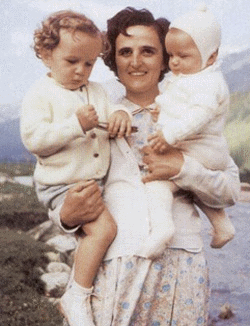
Gianna was happy in married life. She and Pietro moved to a villa in Ponte Nuovo. The local church, Our Lady of Good Counsel, was located close by and Gianna would attend Mass daily. Between 1956 and 1959, she gave birth to three children, Pierluigi, Maria Zita and Laura. However, in 1961, she suffered from two miscarriages. After she became pregnant again, doctors found a tumor on her uterus. The doctors told Gianni she only had three treatment options: remove her uterus, remove the tumor and the unborn child or remove only the tumor. The first option meant that Gianni would not be able to have any more children. The second option would mean the loss of her unborn child. The third option was the riskiest. As a doctor herself Gianni was aware of the risk, but chose the third option because it would ensure the birth of her daughter. She told the doctors, “If you must choose between me and the baby, no hesitation; choose – and I demand it – the baby. Save her!”

The surgery was performed successfully and Gianna returned home. However, the next seven months of her pregnancy were full of complications. Nonetheless, Gianna bore these trials patiently because she knew that her unborn daughter had a right to be born. Finally, Gianna returned to the hospital in April 20, 1962 (Good Friday) to give birth to her fourth child. After natural methods failed, Gianna Emanuela was delivered via Cesarean Section. Shortly after the birth, Gianna suffered from abdominal pains and high fever. She lingered for seven days. She wished to receive Holy Communion one last time before she died, but was unable to because of intense vomiting. Gianna Mollo went to her eternal reward on April 28, 1962 at the age of 39. She was canonized on May 26, 2004 by Blessed Pope John Paul II. Her feast is celebrated on April 28.

Posted in Roman Catholic, Saints | Tagged , | 1 Comment