St. Nicholas (270 – 343)

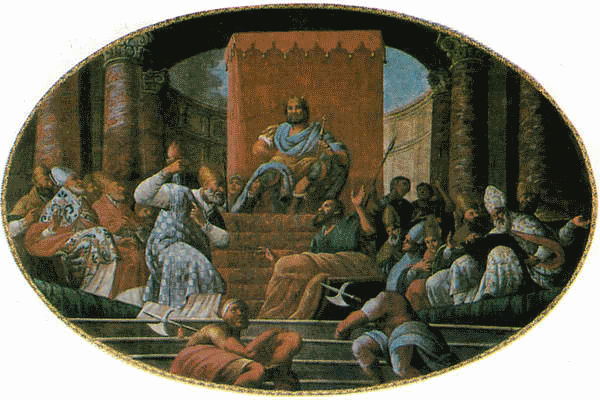
St. Nicholas and Arius

St. Nicholas and Arius

St. Nicholas was born in 270 in the Greek city of Patara. He was the only child of wealthy Christian parents. From a very young age, Nicholas was very religious. According to legend, he would observe the traditional fasts on Wednesday and Friday by only eating one meal. His parents died while he was still young and he went to live with his uncle, also named Nicholas, who was a bishop. His uncle later ordained Nicholas a priest.

Nicholas had inherited a sizable fortune from his parents and decided to devote those funds to works of charity. There are many tales of his generosity. One of these stories had to do with a poor man and his three daughters. The man could no longer afford to care for his daughters and could not find them husbands because of their poverty. The father had no choice but to give his daughters over to a life of sin. When Nicholas heard of this, he took a bag of gold and threw it through the man’s window at night. Upon finding it the next morning, the man used it as a dowry for his oldest daughter, who was soon married. Nicholas did the same two more times, for each of the remaining daughters. The third time, the poor man concealed himself to discover the identity of his benefactor. Upon seeing Nicholas toss the sack of gold in his window, the man rushed up and profusely thanked the saint.

Sometime later, Nicholas became the bishop of Myra. It happened that while the people of the city were electing a new bishop, God indicated that Nicholas was the man to be chosen. This was at time of great persecution for the Church. Because of his position as religious leader of the city, Nicholas was imprisoned and tortured by the local officials. However, when Constantine became emperor and issued the Decree of Milan in 313, Nicholas and the other Christian captives were freed. Through his constant and tireless efforts Nicholas kept his diocese free from the heresy of Arianism, which taught that Jesus Christ was not equal to God the Father in the Trinity.

In order to correct the errors and heresy of Arius, the Emperor Constantine convened the First Ecumenical Council of Nicaea in 325. During the course of this council and while the heretic Arius was speaking, Nicholas could endure his blasphemy no longer. Rising, he punched Arius, knocking him to the floor. This act so shocked everyone that Nicholas was stripped of his copy of the Gospels and his pallium, both signs of his office. On top of this, Nicholas was also thrown in jail. That night Our Lord and Our Lady appeared to him. Our Lord asked, “Why are you here?” Nicholas replied, “Because I love you, my Lord and my God.” In replied, Our Lord gave the copy of the Gospels that had been taken from him and Our Lady vested him with the pallium. When he heard the Nicholas had been restored to his ecclesial position by Heaven, Constantine ordered that Nicholas be released at once.

Nicholas also cared for the temporal welfare of his people. Once, the local governor Eustathius was bribed to condemn three innocent men to death. Before they could be executed, Nicholas appeared and stopped the execution. He berated Eustathius until he admitted that he had been bribed. He freed them and confessed his sin. St. Nicholas died in the year 343.
Posted in Heresy, Priest, Roman Catholic, Saints | 1 Comment

St. Francis Xavier (1506 – 1552)

Today is the feast of St. Francis Xavier, so

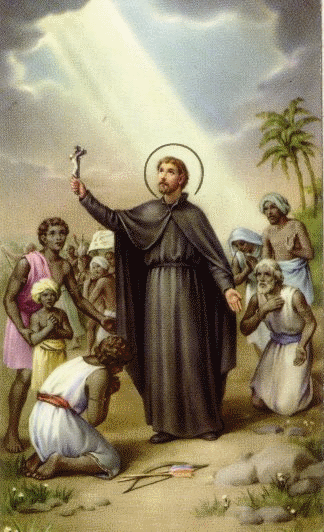
Saint Francis Xavier

Saint Francis Xavier

St. Francis Xavier was born on April 7, 1506 in the Kingdom of Navarre in Northern Spain. He was born into a wealthy aristocratic family. His father died when he was nine, following an invasion of the kingdom by Castile and Aragon. As a result of the family’s activities to regain independence, the Xavier family’s lands were confiscated, their castle’s defenses were demolished and the moat was filled in.

In 1525, Francis went to Paris to study. Here, he met St. Ignatius of Loyola and they became close friends. In 1534, Francis, Loyola and five others founded the Society of Jesus, also known as the Jesuits. They were all ordained in June of 1537. Following his ordination, Francis became interested in missionary work. When he left for the missionary field, Francis only took with him a breviary, a catechism and a book on Biblical inspiration.

At the request of King John III of Portugal, Francis’ first stop was the Portuguese portion of India in 1541. He refused to take a servant with him, saying that as long as he had the use of his hands and feet he would wait on himself. When someone remarked that it was unbecoming for someone of a noble house to care for himself, Francis replied that he could cause no scandal if he did no evil. Here, he worked to convert the natives. For a while he lived in a sea cave as he worked with the natives. He built nearly 40 churches along the eastern coast of India. Francis initially met with limited success because he focused on converting the lower classes. He also worked to reconvert Portuguese who has fallen away from the faith. Francis’ next missionary stop was Indonesia in 1545. Francis had more success here. His efforts laid the groundwork for a permanent mission. He is known as the Apostle of the Indies because of these successes.

In December of 1547, Francis met a Japanese man named Anjiro. Anjiro had heard of Francis and wanted to meet him. Francis learned the Japanese customs and culture from him. Francis had not been aware of the existence of Japan and was thrilled to hear that there were new countries to proselytize. These two and three other Jesuits returned to Japan in 1549. One of Francis’ first actions was to gain an audience with the Emperor. At first, he had quite a bit of trouble learning the language. Instead, he used paintings that he has brought with him of the Madonna and Child as visual teaching aids. He translated some important books on the Faith into Japanese. Because poverty was not as well received in Japan as in other countries, Francis dressed in fine clothes and had several of his companions act as attendants. This made it easier to preach to the Japanese nobility. After two and a half years of missionary work in Japan, Francis returned to India.

His next goal was spread the Gospel in China. He sailed for China on the Santa Cruz. However, before he could land, he died from fever and exhaustion on December 3, 1552 with a single companion by his side. He had survived three shipwrecks during his work in the missionary field and multiple attacks from hostile Muslims. He converted ten of thousands to Catholicism. He is said to have converted more people than anyone since St. Paul. Francis laid the groundwork and created the methods that Jesuit missionaries would use for years to come. He was canonized on March 12, 1622 by Pope Gregory XV.

Posted in Missionary, Priest, Roman Catholic, Saints | Tagged , , , , | Leave a comment

St. Kateri Tekakwitha (1656 – 1680)

In honor of Pope Benedict’s canonization of two new saints back in October, here is a biography for St. Kateri Tekakwitha.

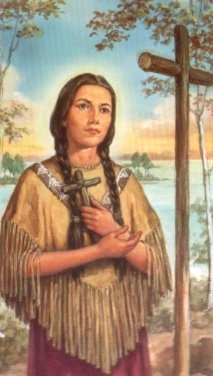
St. Kateri Tekakwitha

St. Kateri Tekakwitha was born around 1656 in a Mohawk village near today’s Auriesville, New York. Her father was a pagan Mohawk chief and her mother was Roman Catholic Algonquin who had been captured by the Mohawks. When she was four years old, Kateri’s parents and brother died from an outbreak of smallpox. The disease also left Kateri with scars and impaired vision.

Now an orphan, Kateri was adopted by her maternal uncle, a chief of the Turtle Clan. In 1667, Jesuits missionaries visited the village of Caughnawauga where she lived. During their three day stay, Kateri took care of them and was impressed by their piety and kindness. He uncle was unhappy with her contact with the Jesuits because he did not want her to convert. However, God had other plans. In 1675, she started studying catechism under the Jesuit Father Jacques de Lamberville. The following year she was baptized on Easter Sunday 1676.

Her conversion resulted in persecution. Her uncle threatened her with death and some Mohawks accused her of sorcery and promiscuity. Finally, Fr. Lamberville suggested that she escape to the Jesuit mission of Kahnawake near Montreal, Canada. In the fall of 1677, Kateri and three other converts managed to escape and make their way to the mission. It was here, under the guidance of her mother’s best friend, that Kateri’s faith grew and deepened.

While in Caughnawauga, Kateri and other converts had practiced mortification of the flesh and devoted their bodies to God. They often did this in a group to relieve their people of their past sins. Kateri would put thorns on her sleeping mat and lie on them while praying for the conversion of her kinsmen. Her relatives had tried many times to get Kateri to marry, but she instead wanted to live a life of chastity. She said, “I have deliberated enough. For a long time my decision on what I will do has been made. I have consecrated myself entirely to Jesus, son of Mary, I have chosen Him for husband and He alone will take me for wife.” Every morning, even in the worst weather, Kateri would rise early and wait outside the chapel until the doors were unlocked at four AM. She would remain until after the last Mass finished.

Kateri’s health had never been particularly good and it worsened as time went on. Her spiritual directors feared that her bodily mortification was causing her health to deteriorate. Fr. Cholonec suggested that Kateri join in the winter hunt to restore her health. She replied. “”It is true, my Father, that my body is served most luxuriously in the forest, but the soul languishes there, and is not able to satisfy its hunger. On the contrary, in the village the body suffers; I am contented that it should be so, but the soul finds its delight in being near to Jesus Christ. Well then, I will willingly abandon this miserable body to hunger and suffering, provided that my soul may have its ordinary nourishment.” During Holy Week of 1679, Kateri’s health began to fail. She died on April 17, 1679 at 24 years of age. After her death, the smallpox scars that had marked her face in life were miraculously healed and her face became remarkably beautiful. Kateri’s gravestone reads: Kateri Tekakwitha – The fairest flower that ever bloomed among red men.” She was canonized by Pope Benedict XVI on October 21, 2012.

Posted in Roman Catholic, Saints | Tagged , , | Leave a comment

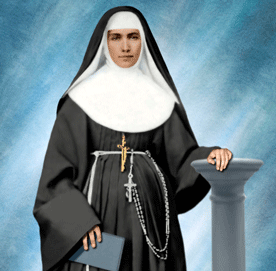
St. Marianne Cope (1838 – 1918)

In honor of Pope Benedict’s canonization of two new saints back in October, here is a biography for St. Marianne Cope.

St. Marianne Cope

St. Marianne Cope was born on January 23, 1838 to Peter Koob and Barbara Witzenbacher in the Grand Duchy of Hesse (modern-day Germany). She had ten siblings. The year after she was born her family immigrated to Utica, New York. From an early age, Marianne experienced a calling to religious life. However, her father became ill while she was in the eighth grade. Because she was the oldest, she took a job as a factory worker to support the family.

After her father’s death in 1862, Marianne’s siblings were old enough to support themselves. Now free from family responsibilities, she entered the novitiate of the Sisters of the Third Order Regular of Saint Francis in Syracuse, New York. After completing a year of formation, Marianne received the habit of a Franciscan sister. She started work as a teacher and later became a principal in a school for German-speaking immigrants in New York.

In the 1860s, Mother Marianne became a member of the governing board of her community. As part of this board, she was involved with establishing two of the first hospitals in the central New York area. Over the next two decades, Marianne worked as a nurse-administrator in several hospitals. Here, she became known for accepting outcast patients, such as alcoholics, and for her kindness, wisdom and practicality. She also required hand washing before treating patients before it became a standard practice. Many said there was no challenge too great for her.

In 1883, Mother Marianne received a request from King Kalakaua of Hawaii requesting help to care for those afflicted with leprosy. Fifty congregations had already refused his request, but Mother Marianne could not turn down such a request. She said, “I am hungry for the work and I wish with all my heart to be one of the chosen Ones, whose privilege it will be, to sacrifice themselves for the salvation of the souls of the poor Islanders… I am not afraid of any disease, hence it would be my greatest delight even to minister to the abandoned ‘lepers.’ Mother Marianne and six of her Sisters set out for Hawaii and arrived in November of the same year. Mother Marianne opened several hospitals for lepers. After seeing the abuse that leprosy patients were suffering at the hands of the government administrator, Mother Marianne demanded to be given full-charge of the hospital or the sisters would return to America. She was given control of the hospital. In two years, she accomplished so much that the King bestowed the Cross of a Companion of the Royal Order of Kapiolani on Mother Marianne for her work to relieve his suffering people

A new government enforced the exile of all lepers to the island of Molokai in 1888. Mother Marianne was asked if she would continue to care for the lepers on Molokai. This would mean that she would never be able to return to New York or see her family again. She replied, “We will cheerfully accept the work.” Once on the island, Mother Marianne took care of St Damien, known around the world as the Apostle of the Lepers, as he lay dying from the same disease his parishioners suffered from. After he had contracted the disease, St. Damien had been shunned by both civil and Church leaders. Mother Marianne, alone, cared for him. After, St. Damien died on April 15, 1889, Mother Marianne took charge of his ministry on the island. In the long run she succeeded in bringing many of St. Damien’s plans to fruition. Throughout the stress and hardships of caring for the lepers of Molokai, Mother Marianne continued to be an example of optimism and trust in God, inspiring many of those around her. Mother Marianne died on August 9, 1918 of natural causes. The fact that she never contracted leprosy was seen as a miracle by many. She was canonized by Pope Benedict XVI on October 21, 2012.

Posted in Roman Catholic, Saints, Tradition | Tagged , , | 1 Comment

Blessed Miguel Pro (1891-1927)

Yesterday was the feast of Blessed Miguel Pro. I did not have a chance to put this up yesterday, but here is a biography that I wrote on Blessed Pro for my parish’s bulletin. Enjoy and Viva Cristo Rey.

Blessed Miguel Pro was born on January 13, 1891 in the town of Guadalupe in the Mexican state of Zacatecas. His father was a mining engineer and his mother was a dedicated homemaker. Miguel was the third of eleven children. From a very young age he was known for his fondness for humor and practical jokes.

When he was very young, Miguel was given some bad fruit by an unsuspecting Aztec woman who idolized him. He was struck was a serious illness that affected his brain. The doctors told his parents that he would either die or become mentally handicapped. Miguel lived for a year, unable to speak or recognize his parents. Finally, when Miguel was near death, his father took him in his arms and knelt before an image of Our Lady of Guadalupe. Looking at the image, Senor Pro prayed, “Madre mia, give me back my son.” Shortly thereafter, Miguel came out of his death trance. Several days later, he was restored to health, both mentally and physically.

Starting in 1910, two of Miguel’s sisters entered the convent. This inspired Miguel to think about his own vocation. On August 10, 1911, Miguel entered the Jesuit seminary in El Lana. He continued his studies until 1914, when anti-Catholic persecution by the government forced him and many others to flee the country. He traveled to California, Spain, Nicaragua and Belgium, all the while continuing his studies. He was ordained on August 31, 1925. Meanwhile back in Mexico, the government had taken away the clergy’s civil rights and they were prohibited from wearing clerical garb in public. Many other laws were passed with the goal of suppressing the Catholic Church.

In the summer of 1925, Miguel returned to Mexico. Because of the continuing and increasing persecution of Catholics, he was forced to practice his priesthood in secret and wear disguises to move about. One time, he had his picture taken in front of a police station, while in disguise, as a policeman passed. On another occasion, he was being pursued by the secret police. Coming alongside a young lady, he said, “Help me. I am a priest.” The couple pretended they were lovers until the police gave up the search. Miguel wore a wedding ring for just such an emergency. After surviving many close calls in the service of God’s people, Miguel was finally arrested in November of 1927.

Hoping to make an example of the young priest, President Calles ordered that Miguel be executed without a trial on November 23, 1927. Calles also had photographers on hand to document the execution. After blessing the soldiers in the firing squad, Miguel knelt to say his final prayers. With a Crucifix in one hand and a Rosary in the other, Miguel faced the firing squad with his arms in the form of a cross. His last words were “Viva Cristo Rey!” – “Long Live Christ the King!”. Ignoring the laws against public demonstrations, 40,000 people lined his funeral procession, which passed under President Calles windows. Another 20,000 waited at the cemetery. The pictures of the execution in the newspapers, instead of destroying the will of the Catholic Cristeros fighting for their faith, actually increased it. Miguel was beatified by Pope John Paul II on September 15, 1988.

Posted in Priest, Roman Catholic, Saints | Tagged | Leave a comment

The Anglican Church Continues Its Steady Journey Towards Oblivion

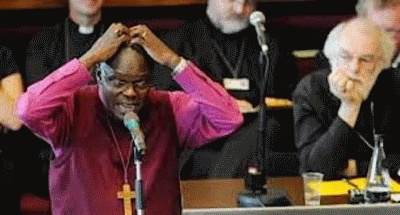
The Archbishops of York and Canterbury

Today, during the course of its annual general synod, the Anglican Church voted on the subject of women bishops. Contrary to the expectations of everyone (including this writer), this legislation was not passed. Don’t start rejoicing and proclaiming that there is hope for the Anglican Church just yet because the vote failed by a whole four votes in the House of the Laity. The interesting part of this story is that all of the leading Anglican clergy have been campaigning hard for women bishops. One of those leading the charge is the exiting Archbishop of Canterbury, Rowan Williams (who loses credibility every time he smiles because he looks like an aging Grover from the Sesame Street). Williams wanted to get women bishops approved before his tenure ended this year. It might have looked like he failed, but with the results that we saw today it will not be long before he gets his wish.

Who thought this was a good idea?

This vote show a difference of opinion between the clergy of the Anglican Church and the laity. It is just another sign of the fractures within the Church of England (C of E) and a sign of the coming civil war within the C of E (Damian Thompson said it first). Women clergy is one of the foremost issues that has caused Anglican groups to break away from the main body and often return to Rome, but it is not the only one. There is also a strong division between low church Anglicans (more mainline Protestants) and high church Anglicans (Catholic lite).

One top of that there has been a shift away from England as the center of power and authority and more towards Africa. (The second highest Anglican churchman, the Archbishop of York, was born in Uganda.) Originally, the C of E was used by the Imperial English government to strengthen and unite the empire. But as that empire disappeared and the member nations became independent, so did the branches of the C of E within those nations. (That is why the majority of Anglicanism is different in different parts of the world, both in doctrine and ceremony.) The African branches have tended to be more conservative and as such have sought to distance themselves for their progressive mother church in England. In fact, back in 2008, a number of conservative Anglicans did not attend the Lambeth Conference that takes place every ten years. (This meeting is used by Anglicans bishops around the world to set policy.) Instead, these bishops met in Jerusalem a week before Lambeth at the Global Anglican Future Conference.

Global Anglican Future Conference

The bottom line is that the Anglican Church around the world is in crisis. It is falling apart because of the constant march of modernism and progressivism is undermining its foundation, which was already weak from its break with Rome. A former Anglican priest said that in 50 years there would be no Anglican Church, but I kind of doubt that for one reason: the British Monarchy. The Anglican Church  and the British Monarchy are very intertwined. If the Anglican Church were to go away, it would greatly weaken the monarchy. That being said, the Anglican Church as we know it today will disappear (especially the doctrine). All that will be left will be the outward appearance of a church, all fluff and bright colors, but no substance.

As they go through a very difficult period over the next few years, let’s keep our Anglican brothers and sisters in our prayers. Let’s pray that they will find their way home to Rome.

Posted in Anglican, Church of England, Liberalism, Modernism, Protestants, Women Clergy | Tagged , , , , , , | Leave a comment

The Socialism That You Asked For

My response to the election can be summed up in this video, which I have posted before.

Also, this newer video.

Prayer is the only thing that can protected us in the days ahead. Pray for your friends and family, but also for the clergy and those who will soon become our persecutors. God help us.

Posted in Roman Catholic, Socialism, Video | Tagged , | Leave a comment

Catholics Must Vote Prolife or Face Hell

No matter what anyone says, Catholics must vote for pro-life, anti-abortion, anti-gay marriage, pro-traditional family, and pro-Bible politicians or endanger their immortal soul. This is a topic that every priest and bishop in the United States should have been preaching about for the last year or so. However, the responsibility has fallen to me and other laymen. Any Catholic who dares to vote for an anti-life, anti-family and anti-God candidate must go to Confession and beg God for forgiveness or they will incur God’s wrath on themselves and our country.

There are certain unspeakable acts which Catholics can never support in any way, these acts are intrinsically evil by their nature. They seek to disrupt the natural order that God intended, they destroy life and call down God’s vengeance. These vile acts are murder of the unborn and the destruction of traditional marriage. The problem is that the support of these two acts has become part of the platform of the Democratic Party. Anyone who supports the Democratic Party in any way, by extension, also supports the murder of the unborn and the destruction of traditional marriage.

Many die-hard Democrat supports will say, “But what about immigration or taxes? Those are important too and I will vote for a candidate based on what he will give me.” If you think that way, I guess you had better enjoy this life while you can because this attitude will not help you when you face God the Father on judgment day. When God asks you why you did not help save the children He created or the Sacrament that He created for all time, your material gains in this life will do you no good.

Here is a good Protestant saying what many Catholics clerics are afraid to said for fear it will ruin their all-important popularity or their just as important tax-exempt status.

That is the problem with the world that we find ourselves in. We been taught from birth to seek material comfort and enjoyment at the expense of our eternal souls. We must break this trend before it is too late.

“Aren’t you overreacting?” many of you will ask. “Evil has always been with us and we are still here. Abortion has been around for years, but we are still here.” Fools, how long do you think God will turn the other cheek. Since 1973, over 50 million children have died from abortion in the US alone. For every child that does in the world, a weight is added to the scales of God’s justice. On the other side of the scales is the good works done around the world. That scales is already tipping heavily from the weight of those murdered children. Once it reaches the breaking point (which is very soon), God’s wrathful and vengeful justice will be unleashed.

When you go to vote next week, don’t think about what you can get from the politicians. Think about how you would like to spend eternity: in eternal bliss because you upheld God’s laws or in eternal torment because you rejected God’s laws in favors of passing temporal comfort. Pray that others will do the same. Email and give this article to your silent pastors, liberal relatives and friends. May God have mercy on us if we fail.

Posted in Abortion, Election, Hell, Politics, Roman Catholic | Tagged , , , , | 2 Comments

Venerable Archbishop Fulton Sheen Talks about Angels

Posted in Angels, Archbishop Fulton J Sheen, Roman Catholic, TV, Video | Tagged , , | 1 Comment

Venerable Archbishop Fulton Sheen Speaks on Temptation


Posted in Archbishop Fulton J Sheen, Roman Catholic, Saints, TV, Video | Tagged , , | Leave a comment