The Catholic Theology of Guardian Angels

GuardianAngel1

Since October is the month of the angels, I decided to write this article to remind people of their forgotten guardians.

Everyone is familiar with the imagery of a kindly angel watching over a child. While the most people recognize the picture of the guardian angel, few actually know what the Catholic Church says about guardian angels. My goal is to acquaint you with the theology behind guardian angels, based on the writings of St. Thomas Aquinas, Abbot Anscar Vonier, and others.

It is commonly thought that angels were created for us. This idea is correct, but it would be better to say that “man was created for the angels”. This means that the guidance and protection that the guardian angels give us during our lives has one ultimate goal: to ensure that one day we will be worthy of being their companions in Heaven.

In order to accomplish this goal each human has a guardian angel assigned to him by God. According to Tradition, guardian angels are not assigned to more than one person. Since the job of a guardian angel ends once the soul under his care has passed into eternal life, this one-angel-to-one-person ratio only applies to those of us who are on earth. According to St. Thomas, even the Anti-Christ, the Man of Sin, will have a guardian angel.

However, just because God assigns a guardian angel to us does not necessarily mean that the angel does not perform other tasks. Distance does not exist for angels because they are spirits. Our earthly bodies anchor us to this place because of their physical nature, but angels do not have this problem. When a guardian angel is acting on the human soul, he is present. When he has stopped acting, he has departed. St. Thomas Aquinas points out that the angel has complete knowledge of the soul in his charge, even when he is not present.

In order to perform their duty to the best of their ability, guardian angels are granted entire and intimate knowledge of the soul under his care. No other angel has access to this knowledge. Not even demons, who try to lead souls to Hell, have knowledge as intimate as our guardian angels.
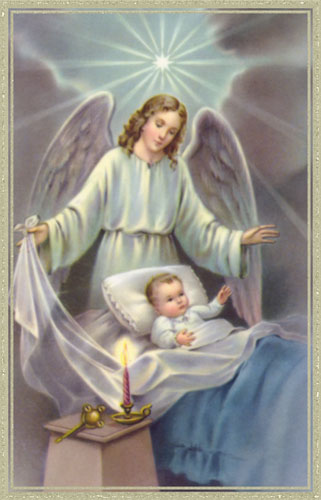
GuardianAngel2With this intimate knowledge, guardians angels have the ability to guide us. They can lead us to new trains of thought and new ideas when we are deep in thought. Angels introduce new thoughts to us so subtly, that they appear to be our own. They can help us make prudent decisions. St. Thomas remarks that if all virtue was given to a soul by God, the virtue of prudence would make external assistance necessary. Angels can also help correct our lower appetites, such as impure desires, when they go against the Divine good. The will, which should rule over these appetites, easily falls prey to them. However, angels are given the ability to satisfy and overcome these lower appetites.

While guardian angels can influence and guide us towards Heaven, the amount of help we receive depends on us. St. Thomas states that the power of a guardian angel to work on the interior life of man is dependant on how that man is spiritually disposed. An angel cannot change a person’s will or affect his intellect. These are things only God can do because He created both the will and the intellect. Guardian angels are limited in their influence by the moral state of the man in their care.

Like everything that God gives us, guardian angels are only beneficial if we would make use of them. Vonier states “Like all Divine gifts, it may be hidden forever in a napkin, and it may be made to produce a hundredfold.” A muscle that is neglected with atrophy, but exercise will strengthen it and make it strong. So too can calling upon the untapped guidance and wisdom of our guardian angels leads us to eternal life with them.

Posted in Abbot Vonier, Angels | Tagged , , | 1 Comment

The Heresy of Sola Scriptura is Unbiblical and Destructive

The heresy of Sola Scriptura (Scripture Alone) was an invention of the 16th century, which has no actual basis in Scripture. Most Protestants point to 2 Timothy 3:16 as the Biblical basis for this heresy, but that does not work for several reasons.

“All scripture is given by inspiration of God, and is profitable for doctrine, for reproof, for correction, for instruction in righteousness.” 2 Timothy 3:16 (KJV)

First, in this verse St. Paul does not say that Scripture alone should be followed. He says that it is “profitable”. Profitable means useful, but not sufficient.

Second, at the time that this epistle was written (between 64 to 68 AD) the Bible as we know it today was not in existence. The last book of the New Testament was written about 100 AD and the canon of Scripture was not compiled until the 4th century. The Scripture that St. Paul was referring to was the Old Testament or the Torah.

To say that “if it is not in the Bible, it is not true” is just plain foolish because the Bible is not an exhaustive record of everything that happened during Bible times. St. John says, “But there are also many other things which Jesus did which, if they were written every one, the world itself, I think, would not be able to contain the books that should be written.” (St. John 21:25, DRB) If everything that Jesus did was not written down, how can you be sure what He condemned and what He did not?

There have been people down through history who did not have Bibles. Take, for example, the early Christians. As stated before, the final book of the Bible was not finished until about 100 AD. The canon of the Scriptures was not formally declared by the Church until the 4th century. After that Bibles were scarce because they had to be laboriously copied by Catholic monks. It wasn’t until about 1440 AD, when Gutenberg invented the printing press, that Bibles were widely owned. Now, what I would like to know is: Would supporters of Sola Scriptura consider these people to be Christian? After all, they lived much closer to the time of Christ, but did not have the Scriptures. The only way they would have received the Gospel would have been through word of mouth and tradition.

Tradition is an integral part of our faith and it’s transmission to us. In 1 Corinthians 11:2, St. Paul said, “Now I praise you, brethren, that in all things you are mindful of me and keep my ordinances as I have delivered them to you.” (DRV) Later in 2 Thessalonians 2:14, he said, “Therefore, brethren, stand fast: and hold the traditions, which you have learned, whether by word or by our epistle.” In both instances, the Apostle mentions word of mouth.

All law-giving writings need to have an interpreter or the meaning will easily be misconstrued or misunderstood. Take, for example, the Constitution of the United States. The Supreme Court was created by the Constitution to do exactly that. In the case of the Bible, the Catholic Church is the interpreter of the Bible. After all Jesus did say to St. Peter, “That thou art Peter; and upon this rock I will build my church, and the gates of hell shall not prevail against it.” (St. Matthew 16:18, DRV) He did not say this about the Bible. In fact, He never mentioned written word when He talked about teaching the Gospel. St. Augustine, who lived between 354-430, said, “I would not believe the Gospel itself, if the authority of the Catholic Church did not move me to do so.” As I heard once, anyone who interprets the Bible for themselves becomes a pope unto themselves.

Sola Scriptura has been very destructive to the body of Christian believers. It has closed the minds of many people to the works of the Fathers of the Church, as well as many mystics, saints and theologians.

Many heresiarchs down through history have used the Bible to justify their heresy. Take the heretic Arius, for example. He read the Bible and was convinced that Jesus was a creature and was not equal with the God the Father. Now, you and I both know that Arius was wrong. Back then, a council was called and his heresy was condemned. That was when the world was overwhelmingly Catholic. If Arius had been born in this century, he would have successfully founded a church and gathered a following. This is what happens when people “become a pope unto themselves” by self-interpreting the Bible.

Finally, if you are going to believe in the Bible alone, which Bible are you going to pick? NIV? KJV? NKJV? NABRE? TNIV? JB? NRS? Each one has a different wording and different phrasing. Besides, there are seven books missing from all Protestant Bibles. So, which version of the Bible has God’s seal of authority and guarantee of no error?

Sola Scruptura has led to nothing, but division and disunity. Pick any verse from the Bible and you will get as many different interpretations as you have people. No wonder there are 40,000+ Protestant denominations.

Posted in Five Solas, Protestant, sola scriptura | Tagged , , , | 1 Comment

Altar Serving Book – Dress Code

LatinMassSadly, today most churches do not have a dress code for their altar boys. While it might not seem significant, a dress code is important because it is meant to help the server understand the importance of what he is doing. Too often, I have seen servers show up for Mass wearing jeans and sneakers or sandals. This is not how an altar boy should dress. And here is why.

First of all, at Mass God the Son comes down from Heaven to be present on the altar under the appearances of bread and wine. If God is going to be in your midst, wouldn’t you want to be dressed up? I certainly would.

Second, most Catholics today have lost this sense of the importance of dressing properly for Mass. By dressing up for Mass, even though your clothes are mostly covered by your cassock and surplice, you are setting an example to the congregation on how they should dress for Mass. They will see how you are dressed when you enter the sacristy and when you leave after Mass.

The typical dress for altar boys should be:

  • Dark pants (preferably black)
  • Dark shoes (preferably black dress shoes)
  • Polo shirt or long-sleeved shirt

There should be no:

  • Sandals
  • Sneakers
  • Shorts
  • Jeans
Posted in Altar Boy, Mass, Roman Catholic, Serving Book | Tagged , , | Leave a comment

Cardinal Burke Does it Again

Recently, Cardinal Raymond Burke gave a very good interview to the Wanderer magazine. I suggest that you read it. You can find it here. Michael Voris did two very good Vortex episodes on the interview. Enjoy.

Posted in Cardinal Burke, Michael Voris, Video | Tagged , , | Leave a comment

The Truth about Islam

There are a lot of different explanations of the origins and beliefs of Islam. Most of what is available is incorrect because misinformation. Catholics need to beware of the history and beliefs of their past and future enemy.

Hillary Belloc called Islam one of the great heresies in his book by the same name. Here is part of what he said.

“Mohammedanism was a heresy: that is the essential point to grasp before going any further. It began as a heresy, not as a new religion. It was not a pagan contrast with the Church; it was not an alien enemy.  It was a perversion of Christian doctrine. Its vitality and endurance soon gave it the appearance of a new religion, but those who were contemporary with its rise saw it for what it was-not a denial, but an adaptation and a misuse, of the Christian thing. It differed from most (not from all) heresies in this, that it did not arise within the bounds of the Christian Church. The chief heresiarch, Mohammed himself, was not, like most heresiarchs, a man of Catholic birth and doctrine to begin with. He sprang from pagans. But that which he taught was in the main Catholic doctrine, oversimplified. It was the great Catholic world-on the frontiers of which he lived, whose influence was all around him and whose territories he had known by travel-which inspired his convictions. He came of, and mixed with, the degraded idolaters of the Arabian wilderness, the conquest of which had never seemed worth the Romans’ while.

He took over very few of those old pagan ideas which might have been native to him from his descent. On the contrary, he preached and insisted upon a whole group of ideas which were peculiar to the Catholic Church and distinguished it from the paganism which it had conquered in the Greek and Roman civilization. Thus the very foundation of his teaching was that prime Catholic doctrine, the unity and omnipotence of God. The attributes of God he also took over in the main from Catholic doctrine: the personal nature, the all-goodness, the timelessness, the providence of God, His creative power as the origin of all things, and His sustenance of all things by His power alone. The world of good spirits and angels and of evil spirits in rebellion against God was a part of the teaching, with a chief evil spirit, such as Christendom had recognized. Mohammed preached with insistence that prime Catholic doctrine, on the human side-the immortality of the soul and its responsibility for actions in this life, coupled with the consequent doctrine of punishment and reward after death.”

The following videos are part 1 and 2 of a very interesting lecture given by Dr. Bill Warner on Islam. Dr. Warner’s information is based on his reading of original sources, including the Koran.

Posted in Islam, Video | Tagged , , , | Leave a comment

A Word to the Wise

FoundationOfTheChurch.final

Posted in SSPX | Tagged | Leave a comment

Pope St. Pius X (1835 – 1914)

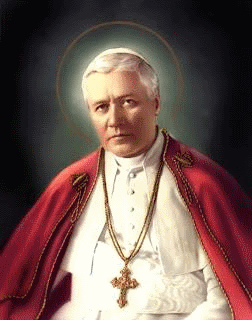
PopePiusXHaloPope St. Pius X was born Giuseppe Melchiorre Sarto on June 2, 1835. His father was a postman in the town of Riese, Italy.  He was the second of ten children. Even though his family was poor, education was very important to his parents and Sarto walked 4 miles to school. This love of education would be evident during his life, as he always made sure that the young could get a religious education.

After studying Latin with his parish priest, Giuseppe entered the seminary. He was ordained a priest in 1858. After working in a parish and teaching in a seminary, Sarto was made Bishop of Treviso in 1879. As a priest and bishop, he worked to make religious education available to youths who would not have had the opportunity otherwise. On June 12, 1893, Pope Leo XIII made him a cardinal and three days later he was named the Patriarch of Venice.

On July 10, 1903, Pope Leo XIII died and at the end of the month the conclave met to elect a new pope. Many doubted that Sarto had a chance to be elected because of his conservatism. Before the conclave, someone told him that he would not be elected Pope. Sarto replied, “Thanks be to God, as I bought a round-trip ticket.” On the first ballot, Sarto only received five votes, but as time went on the number increased. When he saw the vote going in his favor, Sarto pleaded with his brother cardinals, “For the love of God, forget about me. I do not have the qualities to be pope. When it became clear that he had won, he said “I accept as one accepts a cross.” He was crowned Pope Pius X on August 9, 1903.

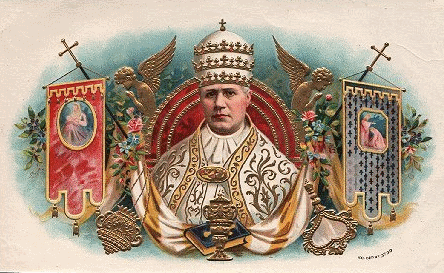
PopePiusXBannersUpon becoming pope, Pius X took the motto “Instaurare omnia in Christo” – “To restore all things to Christ”. These words would define his papacy. Being a humble man, he greatly reduced the Papal ceremonies. He abolished the custom of applauding the Pope in St. Peter’s, saying that it was not “fair to applaud the servant in the home of the Master.” He promoted daily Communion for Catholics as a way to draw closer to God. He reduced the required age for First Holy Communion from 12 to 7 years old. Also, he promoted the frequent use of the Sacrament of Penance, so that Communion could be received worthily. He worked to reform seminaries and Church music. Pius X set in motion the creation of the first universal Code of Canon Law. He is remembered to this day for his strong anti-modernism efforts. He went so far as to call liberal Catholics “wolves in sheep’s clothing”. He required all clergy to take an Oath Against Modernism.

Several miracles were performed through Pius X’s intercession during his lifetime. During a papal audience, he was holding a paralyzed child in his arms, when the child wriggled free and ran around the room.  The coming of World War I in 1914 greatly devastated the Holy Father. When he was asked to bless some troops before they left for the front, he replied that he would “only bless peace”. He died on August 20, 1914, after reigning for 11 years. He was canonized by Pope Pius XII on May 29, 1954. He is honored on August 21st.

Posted in Pope Pius X, Roman Catholic, Saints | Tagged , , | Leave a comment

We Don’t Need Dancing Bishops, We Need Leaders

Contrary to what the secular media may think, Pope Francis’ comments during his return flight from Rio to Rome are not what we should be focussing on. Instead it is the disgraceful actions of the bishops at World Youth Day. Before one of the Papal Masses, the bishops got together and practised as flash dance.

These men are not meant to make spectacles of themselves in front of the crowds. They are meant to teach the Faith of Jesus Christ to a fallen world, not to take part in that fallen world. These man are the successors of St. Peter and the Apostles, but instead they act like (and look like) a badly choreographed geriatric dance team. Hundreds of thousands of bishops down through the centuries died to proclaim the Faith and the best way these men could do it is with a dance. I’d hate to think what conservative Protestants (especially those thinking of entering the Church) think when they see this foolishness. We must pray for these men and for the Church. We must pray earnestly that they will wake up before the Barque of Peter is completely destroyed by the rocky waters of modernism that they are steering her through. We must pray very hard indeed.

Posted in Bishops, Liberalism, Liturgical dance, Michael Voris, Modernism, Video | Tagged , | 6 Comments

Answers for Traditionally Minded Catholics

It is the duty of all confirmed Catholics to continue to learn about their Faith. However, many of the sources available on the web are either based on the water down theology that appeared after Vatican II or is written by groups who appear Catholic but are not associated with Rome. Thankfully, there is a new website that fills this void.

Faithful Answers was recently created to give Catholics answer to questions on Faith based on the ancient traditions of the Church. This site is still very new and does not have a large selection of articles currently. However, they have started a project which will be a great help to many people.

What is most interesting about this project for me is the founder. Here is his bio from the site:

Chad Arneson is a former Protestant evangelist and pastor. He served as founding senior pastor of West Bay Assemblies of God in Grand Cayman, Cayman Islands, BWI. He also traveled extensively preaching throughout the United States and various countries as an evangelist. His preaching and teaching were further marked by a very real anti-Catholic sentiment. The grace of his conversion to the Catholic Church resulted in a radical change of direction. As president of Faithful Answers he is doing what he calls his “happy penance” of sharing the life-giving Truth of the One, Holy, Catholic, and Apostolic Church.

The current contributors include two priests: Fr. Chad Ripperger and Fr. Michael Rodríguez. Fr. Ripperger is a member of the Priestly Fraternity of St. Peter and Fr. Rodriguez is a strong supporter of the Latin Mass and also got in trouble with his bishop for promoting the Church’s stance on homosexuality. Please keep these priests and the other contributors in your prayers as they seek to make the One, True Faith available to everyone.

In closing, here are a couple of videos posted on Faithful Answers. Enjoy.

Posted in Catholic, Church Fathers, History, Return to Tradition, Video | Tagged | 2 Comments

The Roots of the Faith Can Be Found in Judaism

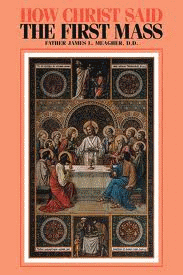
HowChristSaidTheFirstMassThe Catholic Faith is based on the strong foundation of the Jewish religion. You probably have heard this many times, but don’t much beyond it. Well, there is a book that explain in-depth the connection between Judaism and Catholicism. The name of that book is How Christ Said the First Mass. The tremendous book was written by Rev. James L. Meagher. It starts off by detailing the ceremonies and rituals of Judaism. The section is quite extensive and covers the creation of the Ark of the Covenant to the Temple rituals. The last section is a complete description of how the Last Supper took place. It is well work a read for anyone who wishes to learn more about their Catholic faith. Tan books used to carry it, but it is now out of print. However, you can still get a digital copy of it. You can with go here to Archive.org or here is a copy hosted by me.

I greatly enjoyed this book and I hope you do to.

Please comment below if you have read or heard of this book before.

Posted in Book, Catholic, Latin Mass, Mass | Tagged , , , , | Leave a comment